Model to detect defects in soldered components on a Printed Circuit Board.
Optical Inspection Model Card
Model Overview
A Siamese Network is a class of neural network architectures that contain two or more identical subnetworks. The training algorithm works by updating the parameters across all the sub-networks in tandem. It is used to find the similarity between the inputs by computing the Euclidean distance between the feature vectors. In this specific use case, the inputs are a "golden or reference" image and the image of the PCB component under inspection.
Model Architecture
The model in this instance is an Siamese Network architecture.
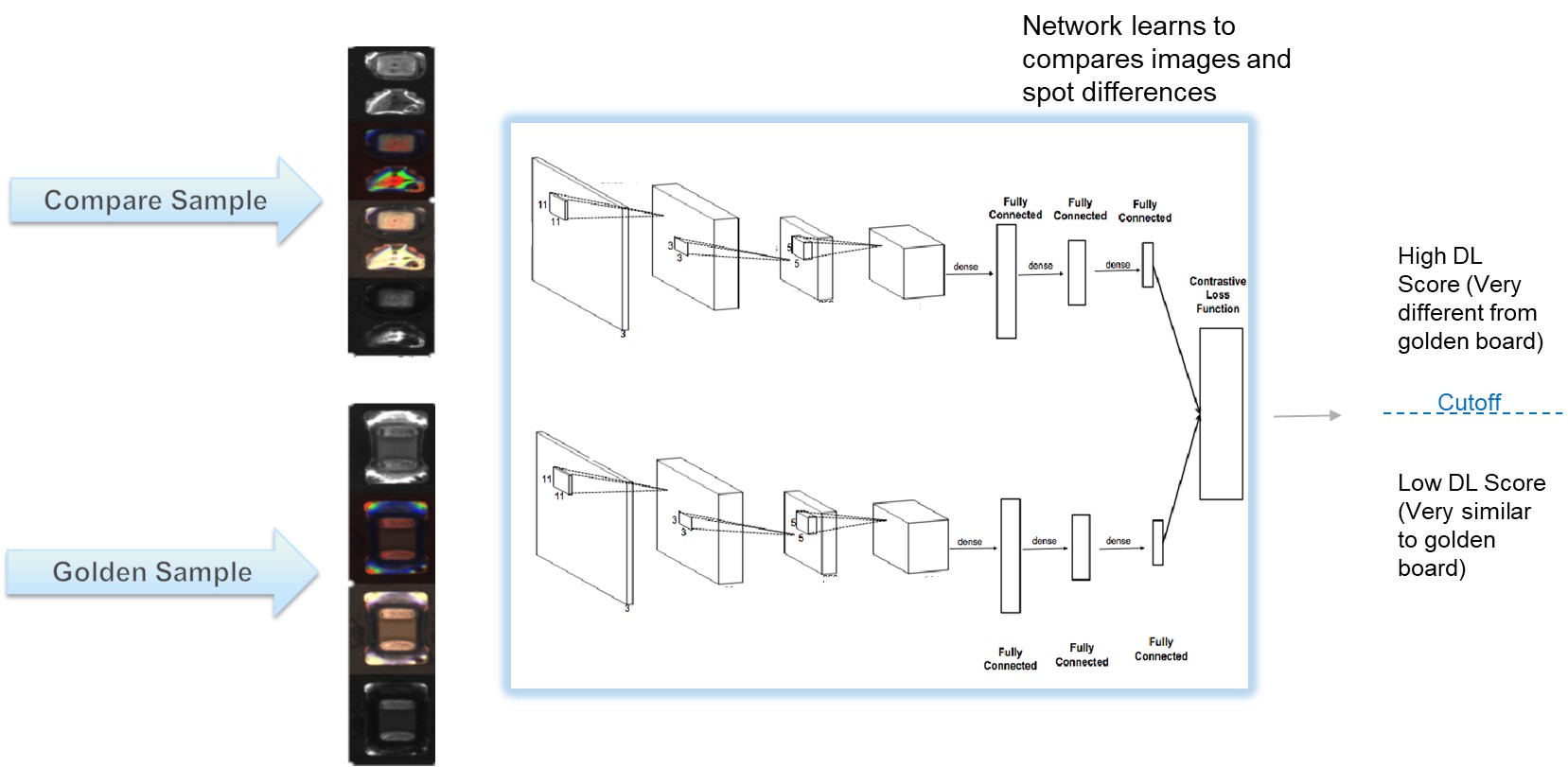
Training
This model was trained using the optical_inspection entrypoint in TAO. The training algorithm optimizes the network to minimize the contrastive loss.
Training Data
Siamese Network model was trained on a proprietary dataset with more than 42207 images of individual components extracted from 105 PCB boards and 4 different PCB designs. The training dataset consists of a mix of components (Resistors, Capacitors, Inductors, etc) from different PCBs.
| Dataset | No. of images | No. of Components | No. of PCBs | No. of Board Designs |
|---|---|---|---|---|
| Nvidia Internal Dataset | 168828 | 42207 | 105 | 4 |
The dataset distribution is represented as under:
| Dataset | No. of components | No of Defects | Defect Rate |
|---|---|---|---|
| Nvidia Internal Dataset | 42207 | 65 | 0.15% |
| Dataset | No. of components | Types of LED illumination per component |
|---|---|---|
| Nvidia Internal Dataset | 42207 | 4 |
Following is an sample image showing a PASS component. The component images shown below were captured under 4 LED illuminations (Solder, Uniform, LowAngle and White). Images for the 4 LED lights were concatenated to display within 2 X 2 grid.
No Defect

Missing Component Defect

Performance
Evaluation Data
The model performance was evaluated on a validation dataset which had a total of 21148 components with 37 components being defective
Methodology and KPI
The performance of the Optical Inspection model is mainly measured using the False Positive Rate (FPR) or False Alarm Rate. It is the proportion of PASS components incorrectly identified as DEFECTS for a given cutoff of the Siamese Score.
| Model | Model Architecture | Testing Images | False Positive Rate (FPR) % | Defect Capture % | Score Cutoff |
|---|---|---|---|---|---|
| Optical Inspection | Siamese Network | 21148 | 0.97% | 100% | 0.3 |
| Optical Inspection | Siamese Network | 21148 | 0.11% | 97% | 0.5 |
Real-time Inference Performance
The inference is run on the provided unpruned model at FP16 precision. The inference performance is run using trtexec on Jetson AGX Xavier, Xavier NX, Orin, Orin NX and NVIDIA T4, and Ampere GPUs. The Jetson devices are running at Max-N configuration for maximum GPU frequency. The performance shown here is the inference only performance. The end-to-end performance with streaming video data might slightly vary depending on other bottlenecks in the hardware and software.
@TODO: Add perflab table
| Model Arch | Version | Inference Resolution | Precision | Xavier NX | AGX Xavier | Orin NX | AGX Orin | T4 | A100 | A30 | A10 | A2 | ||||
|---|---|---|---|---|---|---|---|---|---|---|---|---|---|---|---|---|
| Siamese Network | Unpruned | 2x512x128x3 | FP16 | GPU | DLA1+DLA2 | GPU | DLA1+DLA2 | GPU | DLA1+DLA2 | GPU | DLA1+DLA2 | GPU | GPU | GPU | GPU | GPU |
| - | - | - | - | - | - | - | - | - | - | - | - | - |
How to use this model
These models need to be used with NVIDIA Hardware and Software. For Hardware, the models can run on any NVIDIA GPU including NVIDIA Jetson devices. These models can only be used with Train Adapt Optimize (TAO) Toolkit, or TensorRT.
The primary use case intended for these models is for optical inspection using RGB component level images. The model is a Siamese Network which outputs embedding vectors for image pairs to create a similarity score between them. By applying a euclidiean distance metric on the embedding vectors (golden and sample image pairs) an output score can be generated that indicates whether a component is defective or not.
These models are intended for training and fine-tune using TAO Toolkit and user datasets for image comparison. High-fidelity models can be trained to the new use cases. A Jupyter notebook is available as a part of the TAO container and can be used to re-train.
The models are also intended for easy edge deployment using TensorRT.
Input
Two imput images:
Golden: RGB Image of dimensions: 512 X 128 X 3 (W x H x C)
Sample: RGB Image of dimensions: 512 X 128 X 3 (W x H x C)
Channel Ordering of the Input: NCHW, where N = Batch Size, C = number of channels (3), H = Height of images (512), W = Width of the images (128)
Output
Golden: Embedding: 1 X 5 (N x D)
Sample: Embedding: 1 X 5 (N x D)
Channel Ordering of the Input: NC, where N = Batch Size, D = Number of Dimensions.
Input image
Here is a sample images for a Capacitor with the golden and sample concatenated and displayed side-by-side using a 2 x 2 grid layout
Instructions to use model with TAO
To use these models as pretrained weights for transfer learning, please use the snippet below as template for the model and train component of the experiment spec file to train a Siamese Network model. For more information on the experiment spec file, please refer to the TAO Toolkit User Guide - Optical Inspection.
model:
  model_type: Siamese
  model_backbone: custom
  embedding_vectors: 5
  margin: 2.0
evaluate:
  checkpoint: "${results_dir}/train/oi_model_epoch=004.pth"
Limitations
Expecting 4 LED Illuminations
The Siamese Network model was trained on RGB images using 4 LED lighting conditions namely Solder, Uniform, LowAngle and White lights. Therefore, images captured different lighting conditions or less than 4 LED illuminations may not provide good detection results.
References
Using TAO Pre-trained Models
- Get TAO Container
- Get other Purpose-built models from NGC model registry:
Technical blogs
- Read the 2 part blog on training and optimizing 2D body pose estimation model with TAO - Part 1 | Part 2
- Learn how to train real-time License plate detection and recognition app with TAO and DeepStream.
- Model accuracy is extremely important, learn how you can achieve state of the art accuracy for classification and object detection models using TAO
- Learn how to train Instance segmentation model using MaskRCNN with TAO
- Learn how to improve INT8 accuracy using Quantization aware training(QAT) with TAO
- Read the technical tutorial on how PeopleNet model can be trained with custom data using Transfer Learning Toolkit
- Learn how to train and deploy real-time intelligent video analytics apps and services using DeepStream SDK
Suggested reading
- More information on about TAO Toolkit and pre-trained models can be found at the NVIDIA Developer Zone
- Read the TAO getting Started guide and release notes.
- If you have any questions or feedback, please refer to the discussions on TAO Toolkit Developer Forums
- Deploy your model on the edge using DeepStream. Learn more about DeepStream SDK
License
License to use this model is covered by the Model EULA. By downloading the unpruned or pruned version of the model, you accept the terms and conditions of these licenses
Ethical Considerations
NVIDIA Optical Inspection model detects defects in objects using images. NVIDIA’s platforms and application frameworks enable developers to build a wide array of AI applications. Consider potential algorithmic bias when choosing or creating the models being deployed. Work with the model’s developer to ensure that it meets the requirements for the relevant industry and use case; that the necessary instruction and documentation are provided to understand error rates, confidence intervals, and results; and that the model is being used under the conditions and in the manner intended.