
Detect a persons eye gaze point of regard and gaze vector.
GazeNet Model Card
Model Overview
The model described in this card detects a person's eye gaze point of regard (X, Y, Z) and gaze vector (theta and phi). The eye gaze vector can also be derived from eye position and eye gaze points of regard.
Model Architecture
GazeNet is a multi-input and multi-branch network. The four input for GazeNet consists: Face crop, left eye crop, right eye crop, and facegrid. Face, left eye, and right eye branch are based on AlexNet as feature extractors. The facegrid branch is based on fully connected layers. Please see the paper in the citations for an example of the model architecture.
Training Algorithm
This model was trained using the GazeNet entrypoint in TAO. The training algorithm optimizes the network to minimize the root mean square error between predicted and ground truth point of regards.
Training Data
GazeNet trainable model was trained on a proprietary dataset with more than 220K Images. The training dataset consists of images taken from cameras mounted at varied heights and angles and with various illumination conditions.
Training Data Ground-truth Labeling Guidelines
The training dataset is created by labeling ground-truth bounding-boxes and landmarks by human labelers. he face bounding box and fiducial landmarks are used to prepare inputs (face crop image, left eye crop image, right eye crop image, and facegrid) to the gaze model. For Face bounding boxes labeling, please refer to the FaceNet model card. For Facial landmarks labeling, please refer to the FPENet model card.
During GazeNet data collection, we asked subjects to look at a dot on the screen, while collecting image data. The X, Y, Z position (point of regard) of the dot in the camera coordinate system are obtained through calibration between camera and screen.
Performance
Evaluation Data
Dataset
The inference performance of GazeNet v1.0 model was measured against 110K proprietary images across a variety of subjects, illuminitation conditions, camera heights and camera angles.
Methodology and KPI
The key performance indicators (KPI) is the error of point of regard. Point of regard is the point at which the eye is looking.
| GazeNet | KPI | |||||||
|---|---|---|---|---|---|---|---|---|
| Content | Position X Error | Position Y Error | Position Z Error | Position XYZ Error | Position XY Error | Theta | Phi | Theta-Phi |
| (in cm) | (in cm) | (in cm) | (in cm) | (in cm) | (in degree) | (in degree) | (in degree) | |
| Evaluation set | 3.55 | 3.93 | 1.66 | 6.29 | 5.92 | 2.48 | 2.45 | 3.9 |
Real-time Inference Performance
The inference uses FP16 precision. The inference performance runs with trtexec on Jetson Nano, AGX Xavier, Xavier NX and NVIDIA T4 GPU. The Jetson devices run at Max-N configuration for maximum system performance. The end-to-end performance with streaming video data might slightly vary depending on use cases of applications.
| Device | Precision | Batch_size | FPS |
|---|---|---|---|
| Nano | FP16 | 1 | 87 |
| NX | FP16 | 1 | 510 |
| Xavier | FP16 | 1 | 704 |
| T4 | FP16 | 1 | 1698 |
How to use this model
This model needs to be used with NVIDIA Hardware and Software. For Hardware, the model can run on any NVIDIA GPU including NVIDIA Jetson devices. This model can only be used with Train Adapt Optimize (TAO) Toolkit, DeepStream 6.0 or TensorRT.
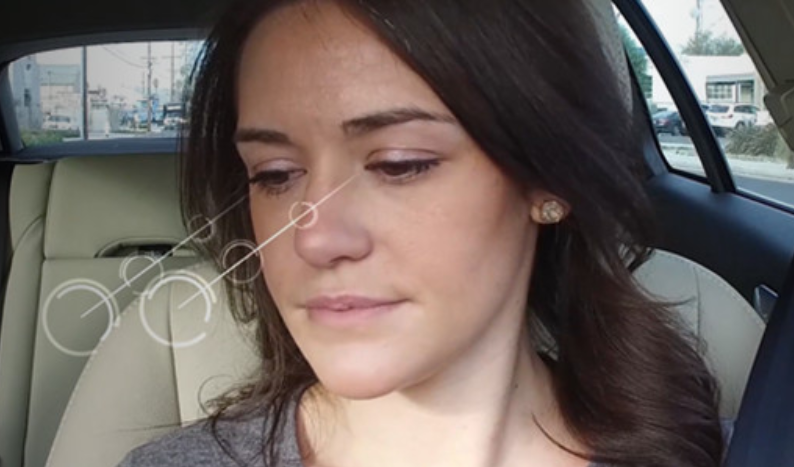
Primary use case for this model is to detect eye point of regard and gaze vector. The model can be used to detect eye gaze point of regard by using appropriate video or image decoding and pre-processing. See the following image for an illustration of eye gaze estimation usage.
There are two flavors of the model:
- trainable
- deployable
The trainable model is intended for training using TAO Toolkit and the user's own dataset. This can provide high fidelity models that are adapted to the use case. The Jupyter notebook available as a part of TAO container can be used to re-train.
The deployable model is intended for efficient deployment on the edge using DeepStream or TensorRT.
The trainable and deployable models are encrypted and will only operate with the following key:
- Model load key:
nvidia_tlt
Please make sure to use this as the key for all TAO commands that require a model load key.
Input
GazeNet is a multi-input network, which takes in face crop image, left eye crop image, right crop image, and facegrid.
- Face Image which is gray scale. 224 x 224 x 1
- Left Eye Image which is gray scale. 224 x 224 x 1
- Right Eye Image which is gray scale. 224 x 224 x 1
- Facegrid Input which are binary mask. 25 x 25 x 1
Output
3D point of regards (X, Y, Z) and gaze vector (theta and phi)
Instructions to deploy this model with DeepStream
To create the entire end-to-end video analytic application, deploy this model with DeepStream.
Limitations
Small faces
NVIDIA GazeNet model does not give good results on detecting small faces (generally, if the face occupies less than 10% of the image area, the face is small)
Model versions
- trainable_v1.0 - Pre-trained model that is intended for training.
- deployabale_v1.0 - Deployment models that is intended to run on the inference pipeline.
References
Citations
Krafka, K., Aditya K., Petr K., Harini K., Suchendra B., Wojciech M., and Antonio T.: Eye tracking for everyone. In: CVPR. (2016)
Using TAO Pre-trained Models
- Get TAO Container
- Get other Purpose-built models from NGC model registry:
Technical blogs
- Read the 2 part blog on training and optimizing 2D body pose estimation model with TAO - Part 1 | Part 2
- Read the technical tutorial on how PeopleNet model can be trained with custom data using Transfer Learning Toolkit
Suggested reading
- More information on about TAO Toolkit and pre-trained models can be found at the NVIDIA Developer Zone
- TAO documentation
- Read the TAO getting Started guide and release notes.
- If you have any questions or feedback, please refer to the discussions on TAO Toolkit Developer Forums
- Deploy your models for video analytics application using DeepStream. Learn more about DeepStream SDK
- Deploy your models in Riva for ConvAI use case.
License
License to use this model is covered by the Model EULA. By downloading the public and release version of the model, you accept the terms and conditions of these licenses.
Ethical Considerations
NVIDIA GazeNet model detects eye gaze point of regard. However, no additional information such as race, gender, and skin type about the faces is inferred.
NVIDIA’s platforms and application frameworks enable developers to build a wide array of AI applications. Consider potential algorithmic bias when choosing or creating the models being deployed. Work with the model’s developer to ensure that it meets the requirements for the relevant industry and use case; that the necessary instruction and documentation are provided to understand error rates, confidence intervals, and results; and that the model is being used under the conditions and in the manner intended.